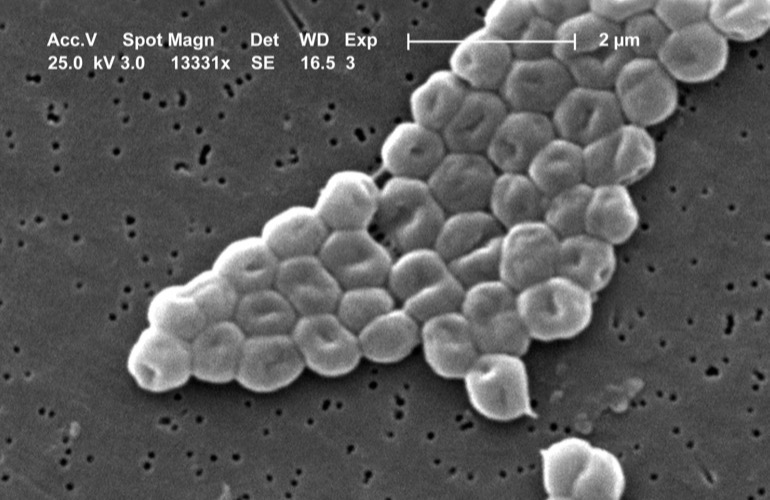
Acinetobacter baumannii, magnified 13,331 times. Credit: CDC/Janice Carr
When new drugs are that scarce, they must reach the patients who need them and be kept from those who don’t. Identifying those patients requires quickly knowing which drugs a given infection resists. And the need is growing. WHO estimates that one in six common bacterial infections is now resistant to antibiotics, and drug-resistant infections were associated with an estimated 4.71 million deaths in 2021.
AI models that read a microbe’s genome and predict which drugs will work could cut the wait for that answer from days to hours. But the data underneath these AI models is not ready. Two major 2026 reviews, one from a EUCAST subcommittee and one from the Align Foundation and Google DeepMind, reach a similar conclusion. Genome-based prediction is advancing, but it depends on reference-quality laboratory testing that much of today’s training data lacks, and public datasets are short on experimentally validated susceptibility results.
Drug developers relying on these AI models to accelerate discovery should ask three questions.
Can the training data be trusted?
Every AI resistance model learns from antimicrobial susceptibility testing (AST), which measures a minimum inhibitory concentration (MIC), or the smallest dose of a drug that keeps the microbe from growing in the lab. Labs then compare that number to a clinical breakpoint to assign a susceptible or resistant category. Those categories are only as durable as the breakpoints behind them.
Breakpoints are revised as evidence accumulates. In 2010, for example, the Clinical and Laboratory Standards Institute (CLSI) lowered its carbapenem breakpoints for Enterobacteriaceae, so an isolate labeled “susceptible” before then might be classed as resistant today. When a label loses that context, it quietly corrupts training data. The raw MIC survives a breakpoint revision and the category does not, which is why MIC values make better training data than susceptible/resistant labels.
The genomes have problems too. In 2020, researchers identified more than 2 million contaminated entries in GenBank, the National Institutes of Health’s (NIH) public sequence database. Each entry is labeled as a single organism but also contains DNA from other organisms, so an AI model trained on it may learn from sequences unrelated to the pathogen.
Then there are the missing negatives. Susceptible isolates rarely make it into public databases because a drug that worked seems unremarkable. However, an AI model needs them to learn to distinguish resistant genomes from susceptible ones.
Does the AI model understand the underlying biology?
Resistance rarely maps neatly onto a list of genes. A gene can be present but silent, and some resistance depends on regulation or cell-to-cell variation that a presence-or-absence check can’t detect. For AI models trained largely on gene content, this creates blind spots. The same genotype can produce different phenotypes, and training data rarely capture the context that explains why. Two examples illustrate the problem.
Acinetobacter baumannii, a WHO critical-priority pathogen, carries a carbapenemase gene from the OXA-51-like family in its own chromosome. It typically drives carbapenem resistance only when a mobile genetic element called ISAba1 inserts just upstream and activates it. An AI model that only checks whether the gene is present will call many susceptible strains resistant.
Heteroresistance is another example. A small resistant subpopulation hides within a mostly susceptible culture, standard testing misses it, and the strain is reported as susceptible. Treatment can then select for the resistant cells. A related problem arises when an isolate’s MIC sits right at the breakpoint. In these cases, ordinary variation between test runs can tip it from susceptible to resistant. These gray-zone cases are where treatment decisions are hardest, and they are scarce in public data.
Will the AI model hold up on strains it has never seen?
A 2024 benchmark study compared four machine-learning (ML) models with ResFinder, a rule-based tool that flags known resistance genes, across 78 species-antibiotic datasets. How the researchers divided strains between training and testing changed the outcome. With a random split, many test strains closely resembled those the models had trained on, and ResFinder outperformed the ML models on only 25% of datasets. When test strains were less closely related to the training strains, ResFinder came out ahead on 44% to 50%. Much of the ML models’ advantage came from strains that were similar to those they had already seen.
This gap between familiar and unfamiliar strains is important because the strains that worry clinicians most are often the ones least like anything in the training set. Without a common test set and fixed data splits, accuracy figures from different teams can’t be compared.
What it will take to build trustworthy AI resistance prediction
Closing these gaps requires reference data built to support an AI model across its entire life cycle.
Build and train. AI models need authenticated strains traceable to a verified source, with genome and MIC generated from the same physical isolate under one reference method, such as ISO 20776-1 broth microdilution, which measures growth across a series of drug concentrations. That way, the genome and the test result are certain to describe the same organism.
Benchmark and validate. The industry needs a shared, community-governed test set that includes verified susceptible strains, borderline strains, and cases where genotype and phenotype disagree, along with fixed, published data splits so accuracy claims can be compared. Once a single isolate anchors the record, any lab can add more data to it, such as protein mass spectra or gene expression under drug exposure.
Monitor and update. Resistance keeps evolving, so benchmarks need regular, documented updates and version control. They also need both recent clinical isolates and historic strains, so developers can test whether a model recognizes resistance as it emerges and evolves, not just as it looked when the model was trained. In ATCC’s work comparing historic and recent Acinetobacter baumannii isolates, the research team observed how these strains progressively acquire resistance genes over time. Training and testing AI models on such temporal collections teaches algorithms how resistance evolves across lineages, helping them catch novel variants earlier and stay reliable as pathogens adapt.
Culture collections can help supply these materials. The ATCC Genome Portal, for example, links authenticated strains to reference-grade genomes and includes pathogens on WHO’s 2024 Bacterial Priority Pathogens List.
Protecting the next generation of antibiotics
New antibiotics earn little at launch, partly because they are rightly held back as last-resort drugs. Fast, accurate AI-based resistance prediction can help get them to the right patients and slow resistance, but only if the models rest on sound reference materials that include authenticated strains, genomes, and MICs from the same isolate, and well-characterized susceptible, borderline, and discordant cases. Those materials also strengthen preclinical test panels for new candidates.
New antibiotics are too scarce to squander. This World AMR Awareness Week, we call on clinical labs, culture collections, drug developers, and AI model builders to share in this work: contributing well-characterized isolates, adopting common benchmarks, and holding AI resistance prediction to the same standard of evidence as the drugs it is meant to protect. That is how these tools will earn and keep clinicians’ trust.
About the authors

Jonathan L. Jacobs
Jonathan L. Jacobs, PhD, is senior director of bioinformatics at ATCC.

Shahin Ali
Shahin Ali, PhD, is a senior scientist at ATCC.
Filed Under: Genomics/Proteomics, Infectious Disease, machine learning and AI